

Marble belongs to history before it ever enters architecture. Its origin lies in the mountain; its cultural journey begins when man recognizes stone as a material that can be extracted, worked, and transformed.
Over time, different civilizations have interpreted its qualities in different ways: compactness, luminosity, resistance, precision of detail, and the ability to define surfaces and volumes. Marble has served as structure, cladding, sculpture, and a symbol of power. Today, it continues to be a material for design, in which performance and presence coexist.
Marble in Antiquity: Form, Light, Permanence
In Greek architecture, marble assumes a central role in shaping an ideal founded on proportion, clarity, and measure. Temples, architectural elements, and sculptures show how the material could serve both function and representation. The surface responded to light, made volumes legible, and allowed for the precise definition of detail.
The Parthenon represents one of the clearest expressions of this relationship: a work of architecture built entirely in marble, in which structure and decoration belong to a single system. Many ancient sculptures were also painted, gilded, or enriched with inlays: marble was therefore not necessarily a monochromatic material, but the foundation for more complex surfaces.

Rome and Lunense Marble: Material, Power, Territory
With Rome, marble enters an urban and political dimension on an even greater scale. It is used in public buildings, temples, baths, villas, columns, flooring, and sculptural programs. The color, provenance, and rarity of materials become part of the symbolic construction of space.
From the age of Augustus onward, marble plays a decisive role in the monumental transformation of the city. Within this process, the Apuan quarries and the stone then known as Lunense marble gain particular importance. The material takes its name from the Roman colony of Luna, now Luni. The proximity of the quarries to the port facilitates extraction, initial processing, and the transport of blocks to Rome and other territories across the Empire.
A network of quarrymen, techniques, trade routes, and expertise thus develops around the stone: a system that connects the mountain to the city and lays the foundations of Carrara’s marble identity.
The Renaissance: Material as Possibility
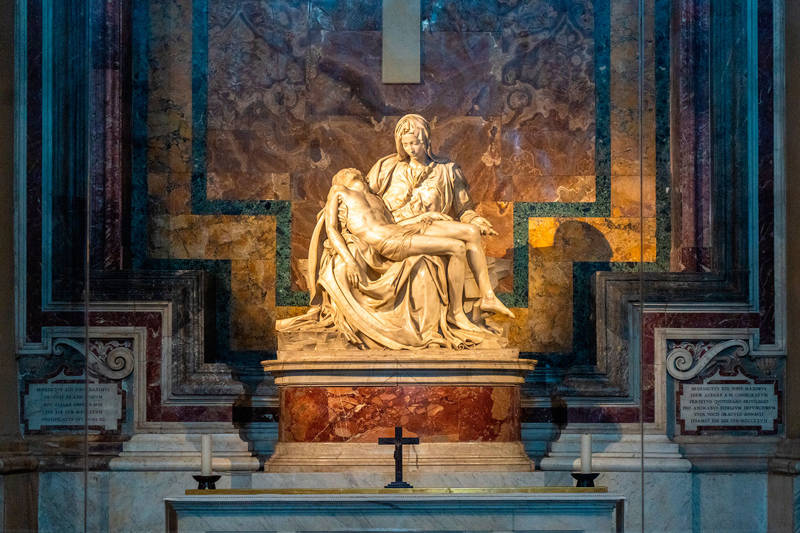
During the Renaissance, the revival of classical culture returns marble to a position of renewed prominence. Stone becomes the meeting point between the study of antiquity, anatomical knowledge, the pursuit of proportion, and technical mastery.
Michelangelo’s relationship with Carrara makes this transformation clear. The artist travelled to the quarries and, with the support of local quarrymen and stonecutters, selected the blocks intended for his works. The choice depended on the structure of the stone, its compactness, and its capacity to sustain the intended form.
The work therefore began before the chisel: in the observation of the block and the reading of its qualities. Marble was not a neutral surface onto which a form could be imposed, but a material to be understood, capable of guiding the gesture and giving it permanence.
From the Traditional Quarry to the Modern Production Process
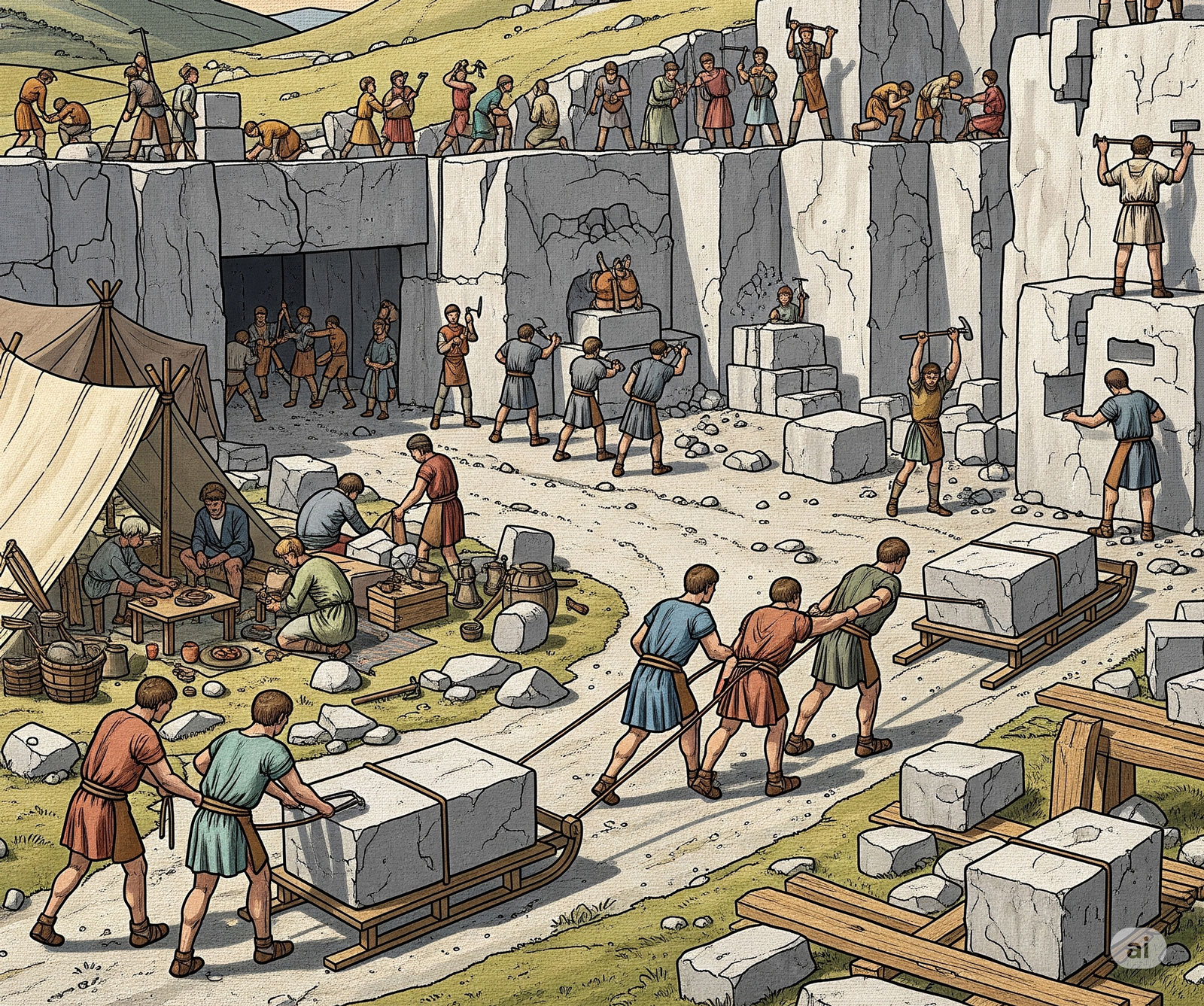
For centuries, extraction and transport required physical labor, experience, and direct knowledge of the mountain. Wedges, levers, and lowering systems made it possible to separate the blocks and bring them down to the valley, according to the rhythms and conditions imposed by the terrain.
Between the nineteenth and twentieth centuries, the development of sawing mills, the Marble Railway, and new cutting techniques progressively changed the scale of the production process. Stone could be moved and worked with greater regularity, while Carrara consolidated its international leadership.
Innovation does not erase previous knowledge, but reorganizes it. From the helical wire to the diamond wire, from gang saws to CNC machinery, the tools change, but the ability to read the material, anticipate its variations, and identify the application best suited to it remains central.

Contemporary Marble: A History Still in Progress
In contemporary architecture, marble is not chosen solely for its historical or decorative value. It enters systems in which performance, stability, construction precision, and perceptual quality must coexist. It defines façades, flooring, continuous surfaces, interiors, custom-made elements, and works of art.
Extraction, scanning, cutting, and processing technologies allow for increasingly precise control, but they do not make the material uniform. Every block retains its own structure; every slab presents variations that must be understood and coordinated.
The history of marble continues every time stone passes from the mountain into space. For Marmi Minucciano, being part of this history means maintaining a direct relationship with the quarries and accompanying the material through every stage of the process, from reading the block to selecting the slabs, through to its application within the project.
The history of marble is rooted in the past, yet its horizons extend toward the future: it will always remain present in the material, in the techniques that evolve, and in the architecture that continues to interpret it.


